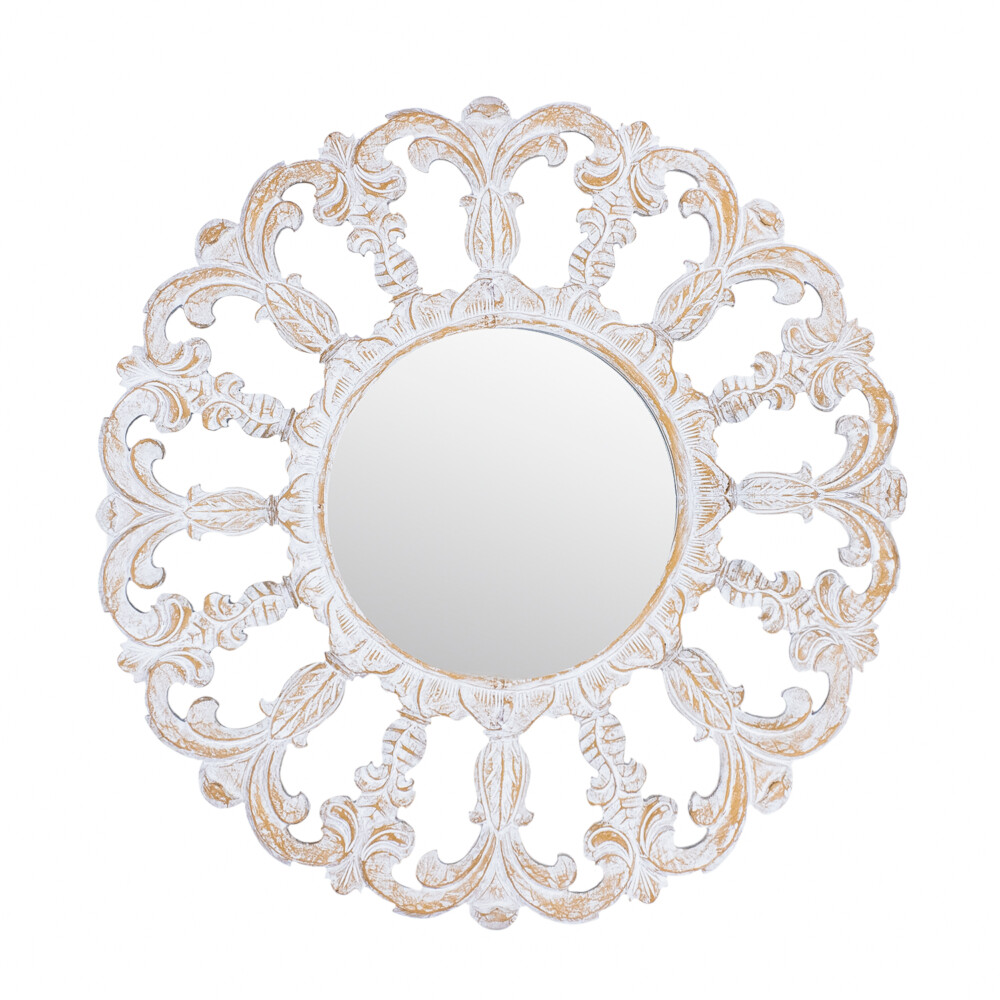
Horizon Round Wooden White Mirror
A substantial 80cm round wall mirror with a sustainably sourced white-painted wooden frame — clean, soft and architectural in form. Built to anchor a wall as a proper sight-line piece rather than to disappear as utility hardware. Suited to coastal, contemporary and Modern Tropical interiors.
– Dimensions: 80 × 80 cm round
– Sustainably sourced solid wooden frame in white finish
– Round silhouette for soft architectural presence
– Substantial scale — proper feature-mirror proportions
– Suited to bedrooms, hallways, entryways, lounges and bathrooms
– No assembly required
- Estimated Delivery : 4 to 10 business days
An 80cm round wall mirror with a sustainably sourced white wooden frame
A wall mirror does two jobs at once. The functional job is obvious — it gives back a reflection, useful in entryways for a final check before leaving the house, in bedrooms for dressing, in bathrooms for grooming. The decorative job is the one most homes get wrong. A well-chosen wall mirror is one of the single most powerful decorative pieces in any room: it bounces natural light into otherwise dim corners, doubles the visual depth of a small room by reflecting the space back into itself, and acts as a substantial sight-line piece that anchors a wall the way a piece of substantial art would. The Horizon Round Wooden White Mirror is built around exactly that kind of dual-purpose intention.
The piece measures 80 × 80 cm — a genuinely generous round mirror at proper feature-piece scale. The frame is constructed from sustainably sourced solid wood, finished in a clean white painted finish that lifts the surrounding wall and bounces natural light into the room rather than absorbing it. The round silhouette is the deliberate choice. It carries a different visual character from rectangular alternatives: softer, more architectural, less directional. Round mirrors read as objects in their own right; rectangular mirrors more often read as utility-and-frame. For buyers who want the mirror to be a noticed piece rather than a quiet utility, round is usually the right answer.
Why a round mirror silhouette works differently from rectangular
The form choice on a wall mirror does specific visual work that goes beyond personal preference. Three things about why round mirrors work where rectangular alternatives don’t are worth understanding.
Round softens architectural angles in a way rectangular cannot. Most homes are built around right angles — square rooms, rectangular doors and windows, vertical walls meeting horizontal floors and ceilings. A rectangular mirror reinforces this geometry; a round mirror provides relief from it. In rooms that already feel boxy or angular (small bathrooms, narrow hallways, square bedrooms), a round mirror introduces a curve that visually softens the broader space.
Round draws the eye without commanding it. A rectangular mirror has a clear “top” and “bottom,” and the eye reads it directionally. A round mirror has no preferential viewing direction — the eye settles on it as a whole rather than scanning across it. This makes round mirrors easier to live with as everyday decor: they hold the eye briefly without dominating attention the way a substantial rectangular piece can.
Round suits the contemporary tendency toward soft-natural styling. South African interior design over recent years has trended away from sharp-modern minimalism toward softer, layered, organic-natural schemes — beach cottage, coastal, Modern Tropical, soft Scandinavian, considered farmhouse. Round mirrors are foundational to all of these aesthetics in a way rectangular mirrors are not. The form ties to the broader curved-organic vocabulary that defines current popular interior styling.
Why white painted wood works for a wall mirror frame
The frame finish on a wall mirror is more important than buyers typically realise — it determines whether the mirror lifts the surrounding wall or competes with it. A few things about the white painted wood choice are worth understanding.
White bounces light rather than absorbing it. A dark frame (black metal, dark stained wood) frames the mirror clearly but absorbs the surrounding light, creating a shadow zone around the mirror itself. A white frame does the opposite — it reflects natural light along with the mirror surface, doubling the light-bouncing function of the piece. In rooms that need help with natural light (small bathrooms, internal corridors, shadow corners), this difference matters.
White ties to almost any wall colour and adjacent furniture. A black or dark-toned frame commits to a strong contrast with most wall colours; a coloured wood frame ties to specific wood tones in the surrounding furniture but conflicts with others. A white frame is the most universally accommodating finish — it works on white, off-white, sage, dusty pink, soft grey and most other contemporary wall colours, and it doesn’t compete with adjacent timber furniture in any tone.
The painted wooden construction is genuinely durable. Solid wood with a quality painted finish handles the long-term wall-mounted role well — no warping, no metal corrosion in humid bathrooms, no flaking finish if reasonably looked after. The sustainably sourced wood means the piece is built to last decades.
Where this round mirror sits best — and the placement physics that matter
Mirror placement is where most South African homes get things wrong — usually by hanging the mirror too high, too low, or in a position where it reflects something unflattering (the ceiling, a door frame, a cluttered corner). The 80 cm scale and round form suit specific placements with specific height conventions.
Above an entryway console as the welcome piece. The most natural placement. Hang the mirror centred above an entrance console, with the bottom edge of the frame approximately 15–25 cm above the top of the console surface. The combined console-and-mirror creates a substantial styled entryway moment for visitors and a final-check mirror for residents leaving the house. The 80 cm round scale balances most standard 100–140 cm wide consoles without overwhelming them.
Above a bathroom vanity as the primary mirror. The 80 cm round scale suits standard vanity widths beautifully — wider than the vanity reads as overpowering, much narrower reads as undersized. Position the centre of the mirror at standard eye level (approximately 145–155 cm from the floor). The white frame handles bathroom humidity well and bounces light around what is often a low-natural-light room.
In a bedroom above a dressing table or chest of drawers. Position centred above the chest of drawers with the bottom edge approximately 20–25 cm above the surface. The round form provides relief from the rectangular geometry of bedroom furniture (rectangular bed, rectangular dresser, rectangular wardrobe) and softens the broader bedroom character.
Above a fireplace or mantelpiece. Position centred above the mantel with the bottom edge approximately 10–15 cm above the mantel surface. A round mirror over a rectangular fireplace creates a deliberate visual contrast between the curved mirror form and the architectural geometry of the fireplace surround.
In a hallway as a sight-line piece. Position at the far end of a long hallway, or at a turn in a hallway, where the mirror reflects natural light back down the corridor. This is one of the highest-impact placements for any wall mirror — significantly improving the perceived light and depth of what is often the dimmest space in a home.
In a small lounge to double the perceived space. A substantial wall mirror positioned opposite a window reflects the view back into the room, effectively doubling the visual depth of the space. This is one of the oldest tricks in interior design and works as well today as it did in nineteenth-century parlour rooms.
Standard hanging-height conventions worth knowing
For any wall mirror, three height numbers help avoid the most common placement mistakes. Above a console or sideboard: bottom of frame 15–25 cm above the surface. Above a fireplace mantel: bottom of frame 10–15 cm above the mantel. Above a vanity, dressing table or chest of drawers: bottom of frame 20–25 cm above the surface, with the centre of the mirror at standard eye level (approximately 145–155 cm from the floor for adults).
What this mirror pairs with
The round form, white finish and 80 cm scale set up specific pairings across the Sotran range. The piece sits naturally as a feature element in Beach Cottage and Modern Tropical styling schemes — both rely heavily on round white mirrors as foundational pieces. For a complete styled wall, position the mirror above pieces from the Sideboards & Consoles range or the Dressers & Drawers range — substantial timber furniture below a soft round mirror is one of the most reliably elegant combinations in interior styling. For a bedroom or lounge scheme, browse the broader Mirrors range and consider how this piece works alongside other reflective and light-bouncing decor — particularly relevant in homes with limited natural light. The light, soft palette also ties beautifully to natural-fibre baskets from the Baskets range and soft textiles from the broader Textiles range.
Caring for a painted wooden mirror frame
One of the practical advantages of a quality painted wooden frame is how easily the piece stays looking fresh for years. Dust the frame periodically with a soft, dry microfibre cloth — the smooth painted surface wipes clean effortlessly without needing any cleaning agent. For occasional deeper cleaning, wipe gently with a barely damp cloth and a small amount of mild soap if needed, then dry immediately to protect the finish.
For the mirror surface itself, use standard glass cleaner sparingly — spray onto the cloth rather than directly onto the mirror to prevent any liquid running behind the frame. Position the mirror out of consistent direct sunlight to preserve the depth of the white paint over the years. With this minimal care, a quality painted-wood mirror frame holds its character for decades — settling into its place on the wall and lifting the room around it for as long as it stays there.
| Dimensions | 80 × 80 cm |
|---|---|
| Product Assembly | No Assembly Required |